

Why Tyre Condition Matters More in Chennai Than Most Cities
Tyres are the only point of contact between your car and the road. Everything the car does, accelerating, braking, cornering depends on the tyre maintaining grip with the surface. In Chennai, two factors make tyre condition more critical than in most other Indian cities. The first is the monsoon season, which runs across two monsoon periods from June to December and creates wet road conditions where tyre tread depth directly determines whether the car stops in time. The second is road surface quality like potholes, sharp debris and broken tarmac edges damage tyres through sidewall impacts and punctures at a rate that accelerates the replacement cycle well beyond what a service book interval assumes.
This guide covers the key indicators that a tyre needs replacing, how to read tyre wear patterns, the age factor that most car owners overlook, and what tyre replacement involves on a European car.
|
Wheel alignment and tyre services at Evolve Automotive → evolveautomotive.in/wheels-rims |
+91 98849 88632 · Mon–Sat 10AM–7PM
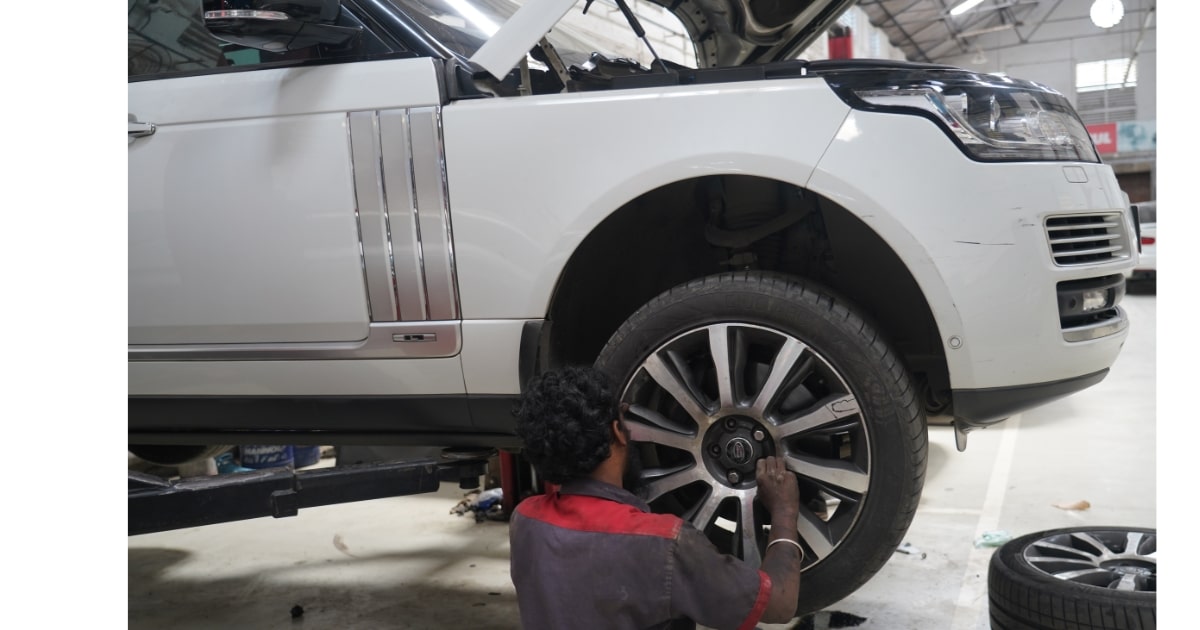
The Four Indicators That a Tyre Needs Replacing
-
- Tread Depth Below the Safe Threshold
Tread depth is the primary indicator of a tyre’s ability to grip a wet road. The tread grooves channel water away from the contact patch between the tyre and the road surface. As the tread wears down, the volume of water the tyre can displace per second decreases. Below a certain depth, the tyre cannot displace water fast enough at normal road speeds, and the tyre rides on a film of water rather than the road surface, this is aquaplaning, and it means the driver has no steering or braking control until the car slows enough for the tyre to regain contact.
The legal minimum tread depth in India is 1.6mm. European car manufacturers and tyre manufacturers recommend replacing tyres at 3mm in wet conditions. The difference between 3mm and 1.6mm in wet grip performance is significant, stopping distances in the wet increase substantially as tread depth drops below 3mm. In Chennai monsoon conditions, treating 3mm as the replacement threshold rather than 1.6mm is the correct approach.
Tread depth is checked with a tread depth gauge or by using the tread wear indicators built into the tyre. Most tyres have small rubber bars moulded into the base of the tread grooves at 1.6mm height. When the tread surface is level with these bars, the tyre is at the legal minimum. If the bars are visible, replacement is overdue.
- Tyre Age Over Five Years
Rubber degrades with age regardless of use. A tyre that has covered low mileage but is six or seven years old has rubber that has hardened and lost its flexibility through oxidation and UV exposure. Hard rubber does not conform to road surface irregularities the way a new tyre does, which reduces grip even when the tread depth is technically adequate. Cracks in the sidewall and tread compound are the visible signs of age-related degradation.
The manufacture date of a tyre is stamped on the sidewall as a four-digit DOT code – the last four digits of the DOT number. The first two digits are the week of manufacture and the last two are the year. A tyre showing 1821 was manufactured in the 18th week of 2021. Most tyre manufacturers and European car manufacturers recommend replacing tyres at five years regardless of tread depth, and treat ten years as an absolute maximum even if the tyre appears visually sound.
In Chennai, UV exposure and heat accelerate rubber degradation compared to European conditions. A five-year replacement interval is appropriate for most cars. Inspect the sidewalls of any tyre over four years old for cracking.
- Uneven Wear Patterns
How a tyre wears across its width tells you what is happening with the car’s geometry and inflation. Uneven wear is a signal that something needs attention beyond just the tyre, replacing a tyre without addressing the underlying cause means the new tyre will wear unevenly in the same way.
- Centre wear – tyre worn more in the middle than at the edges indicates consistent overinflation. The tyre bulges in the centre and only the centre contacts the road.
- Edge wear on both shoulders – tyre worn at both edges with good tread in the centre indicates consistent underinflation. The tyre flattens and only the edges contact the road.
- One-edge wear – tyre worn heavily on the inner or outer edge only indicates a camber or toe alignment problem. The wheel is angled so that one edge of the tyre carries most of the load.
- Cupping or scalloping – an irregular wear pattern where the tread appears to have scooped patches rather than wearing evenly indicates worn shock absorbers. The wheel is bouncing slightly rather than maintaining consistent road contact.
- Feathering – the tread blocks are rounded on one side and sharp on the other, visible and feelable by running your hand across the tread. This indicates a toe alignment issue.
- Visible Damage – Sidewall Bulges, Cuts and Punctures
Sidewall damage is non-repairable in virtually all cases. A bulge in the tyre sidewall indicates that the internal structure of the tyre, the carcass plies has been damaged, typically by a sharp impact with a pothole or kerb. The bulge is the outer rubber layer being pushed out by air pressure where the internal structure has failed. A tyre with a sidewall bulge should be replaced immediately, it is a blowout risk. Chennai’s pothole conditions make sidewall bulge one of the most common damage types we see.
A deep cut in the sidewall that has penetrated to or through the carcass ply is similarly non-repairable. Punctures in the tread area can be repaired if they are within the central three-quarters of the tread and are caused by a nail or similar object of less than 6mm diameter. Punctures at the shoulder of the tyre, or caused by larger objects, require tyre replacement.
European cars are fitted with tyres that are speed-rated and load-rated to specific standards for that model. Replacing a tyre on a BMW, Mercedes-Benz or Audi with a tyre of a lower speed rating or incorrect load index than the manufacturer specifies is not just a performance compromise, it affects the car’s handling balance and may invalidate insurance. Always replace to the specification shown on the tyre placard inside the driver’s door jamb or in the owner’s manual, not just the size.
Tyre Replacement on European Cars — What to Know
Replace in Pairs Minimum
Tyres should be replaced in axle pairs at minimum, both fronts together or both rears together. Mixing a new tyre with a significantly worn tyre on the same axle creates a grip imbalance under braking and cornering. On European cars with sophisticated stability control systems, a significant grip difference between the two tyres on an axle can cause the stability system to intervene in ways that feel unnatural.
Run-Flat Tyres on BMW and Some Mercedes-Benz Models
Many BMW models and some Mercedes-Benz variants are fitted with run-flat tyres from the factory. Run-flat tyres have reinforced sidewalls that allow the car to continue driving for a limited distance after a puncture. They cannot be repaired after running flat. They must be replaced with run-flat tyres of the same specification, fitting a standard tyre on a car set up for run-flats changes the handling characteristics and affects the TPMS calibration. If your BMW came without a spare tyre from the factory, it almost certainly has run-flat tyres.
TPMS Reset After Replacement
European cars with tyre pressure monitoring systems require the TPMS to be reset after tyre replacement so the system learns the new tyre’s pressure baseline. On BMW, Mercedes-Benz and Audi, this is done through the vehicle’s on-board menu or via the diagnostic software. A TPMS warning light that remains on after tyre replacement and inflation indicates the reset was not completed correctly.
|
All European car services at Evolve Automotive Guindy → evolveautomotive.in/premium-cars |
FAQ — Car Tyre Replacement in Chennai
Q: How often should tyres be replaced on a European car in Chennai?
There is no fixed mileage interval because tyre life depends on driving style, road conditions, tyre specification and inflation maintenance. In Chennai conditions, tyres on European cars typically last between 30,000 and 50,000 km depending on the brand and driving pattern. However, the age limit of five years applies regardless of remaining tread depth. Check tread depth every service visit and inspect the sidewalls of any tyre over four years old. In practice, most European car owners in Chennai replace tyres every three to four years due to the combination of mileage and road surface damage.
Q: What is the minimum safe tread depth for Chennai monsoon conditions?
The legal minimum is 1.6mm, but in Chennai monsoon conditions the practical safe minimum is 3mm. Below 3mm, wet grip performance drops significantly and aquaplaning risk in heavy rain increases. European tyre manufacturers specify 3mm as the replacement threshold in wet conditions. Given that Chennai experiences monsoon rain for six months of the year across two monsoon seasons, treating 3mm as the replacement point rather than the legal minimum of 1.6mm is the appropriate approach.
Q: Can I mix tyre brands on a European car?
Mixing tyre brands on the same axle is not recommended. Different brands have different grip characteristics, tread patterns and compound softness, which creates an imbalance across the axle under braking and cornering. Mixing brands between front and rear axles is less problematic but still not ideal. Where possible, fit the same brand and model of tyre across all four positions, or at minimum across each axle. On European cars with all-wheel drive systems, significant differences in tyre diameter between axles caused by different wear levels or different tyre sizes can cause drivetrain stress.
Q: How do I check my tyre age in Chennai?
The manufacture date is on the tyre sidewall as part of the DOT code. Look for a four-digit number near the end of the DOT stamping, for example, 2322 means the 23rd week of 2022. If you cannot locate it, bring the car in and we will check all four tyres and the spare. Tyres over five years old should be inspected carefully for sidewall cracking regardless of tread depth.
Q: Does wheel alignment affect how quickly tyres wear out?
Yes, significantly. A wheel alignment that is outside the manufacturer’s specified range causes the tyre to scrub against the road surface at a slight angle rather than rolling straight. This accelerates wear on one edge of the tyre and reduces overall tyre life. In Chennai conditions where potholes and speed breakers knock alignment out of spec regularly, checking alignment at least once a year or after any significant impact protects tyre life and maintains the handling the car was designed to deliver. At Evolve, alignment is checked on the Hunter HawkEye Elite system to the manufacturer’s published specification for each model.
|
Book a Tyre Inspection at Evolve Automotive 49 & 51/2, Thiru-Vi-Ka Industrial Estate, Guindy, Chennai, Tamil Nadu 600032 Call / WhatsApp: 98849 88632 | Mon-Sat 10AM-7PM wa.me/919884988632 |
|
Tyre inspection, alignment and wheel services in Chennai at Evolve Automotive, Guindy. Hunter HawkEye Elite alignment system. All European and premium car brands. Written estimate before every job. Call / WhatsApp: 98849 88632 | evolveautomotive.in/wheels-rims/ |