

If you drive regularly in Chennai, your car’s suspension and wheel alignment are working harder than the manufacturer ever intended. The engineers who designed your BMW, Audi, or Mercedes-Benz suspension were calibrating it for European road surfaces smooth, well-maintained, with predictable geometry. Chennai offers something quite different: post-monsoon potholes that appear overnight and stay for months, speed breakers at inconsistent heights with no warning, metro construction diversions with loose gravel and uneven temporary surfaces, and peak-hour OMR traffic that turns a 10 km commute into an hour of slow, constant suspension articulation.
None of this destroys a suspension immediately. What it does is accelerate the wear that every suspension system eventually experiences and it does it faster than the service schedule accounts for. Here is what Chennai roads actually do to your suspension and wheel alignment, and what to watch for before the bill gets large.
+91 98849 88632 · Mon–Sat 10AM–7PM
1. Potholes — The Obvious One, but Not Always Where You Expect
Post-monsoon roads across OMR, Velachery, Pallikaranai, and inner-city stretches develop surface depressions that are sometimes visible and sometimes completely hidden under standing water. A pothole hit at 40 km/h delivers a sharp, high-force impact to the suspension that it was not designed to absorb in a single event. Modern suspension systems are built to manage thousands of small impacts over their service life not a series of hard strikes in quick succession.
What actually happens in a significant pothole impact:
- The wheel rim can deform not always visibly, but structurally. A bent rim causes vibration at highway speed and in severe cases, slow tyre deflation
- The tyre sidewall takes the lateral load of the impact and can develop an internal bubble a bulge on the sidewall that indicates the internal cord structure has broken. A bulging tyre should be replaced immediately, not monitored
- The suspension geometry shifts. Camber, caster, and toe angles can all move outside their specified range from a single hard impact. The car may not pull noticeably but the tyres will start wearing unevenly within a few thousand kilometres
- In severe cases, a lower control arm bends, a ball joint cracks, or a shock absorber top mount fractures. These are immediate repairs not items to defer
The single most important habit for Chennai driving: book a wheel alignment check after any significant pothole impact, not when the tyres start looking worn. By the time uneven wear is visible, the misalignment has been working on your tyres for weeks.
2. Speed Breakers — Slow Damage Adds Up Faster Than You Think
Chennai has more speed breakers per kilometre of road than almost any other Indian city and they vary enormously. The well-marked, correctly profiled ones in Nungambakkam are manageable. The unmarked, steeply ramped ones in residential areas near T Nagar and Guindy, hit at anything above walking pace, transfer a significant shock load through the entire suspension.
Unlike a pothole, speed breakers do not cause acute damage in one hit. What they cause is fatigue the repeated compression and rebound of the suspension through its full range, multiple times a day, accelerates wear on:
- Shock absorber seals and piston rods the oil inside the damper starts weeping past worn seals, reducing damping effectiveness gradually
- Strut top mounts — the rubber bearing that allows the suspension to turn with the steering. When it wears, you hear a knocking sound on full steering lock and over bumps
- Anti-roll bar bushings and drop links – these wear faster than most owners realise and are one of the most commonly found worn items on Chennai-driven cars at inspection
- Ball joints – the articulation point between the control arm and the steering knuckle. Worn ball joints produce a clunking sound over bumps and create a handling vagueness that is hard to describe but immediately noticeable once the joint is replaced
3. Wheel Alignment — Why It Drifts and Why It Matters More Than People Realise
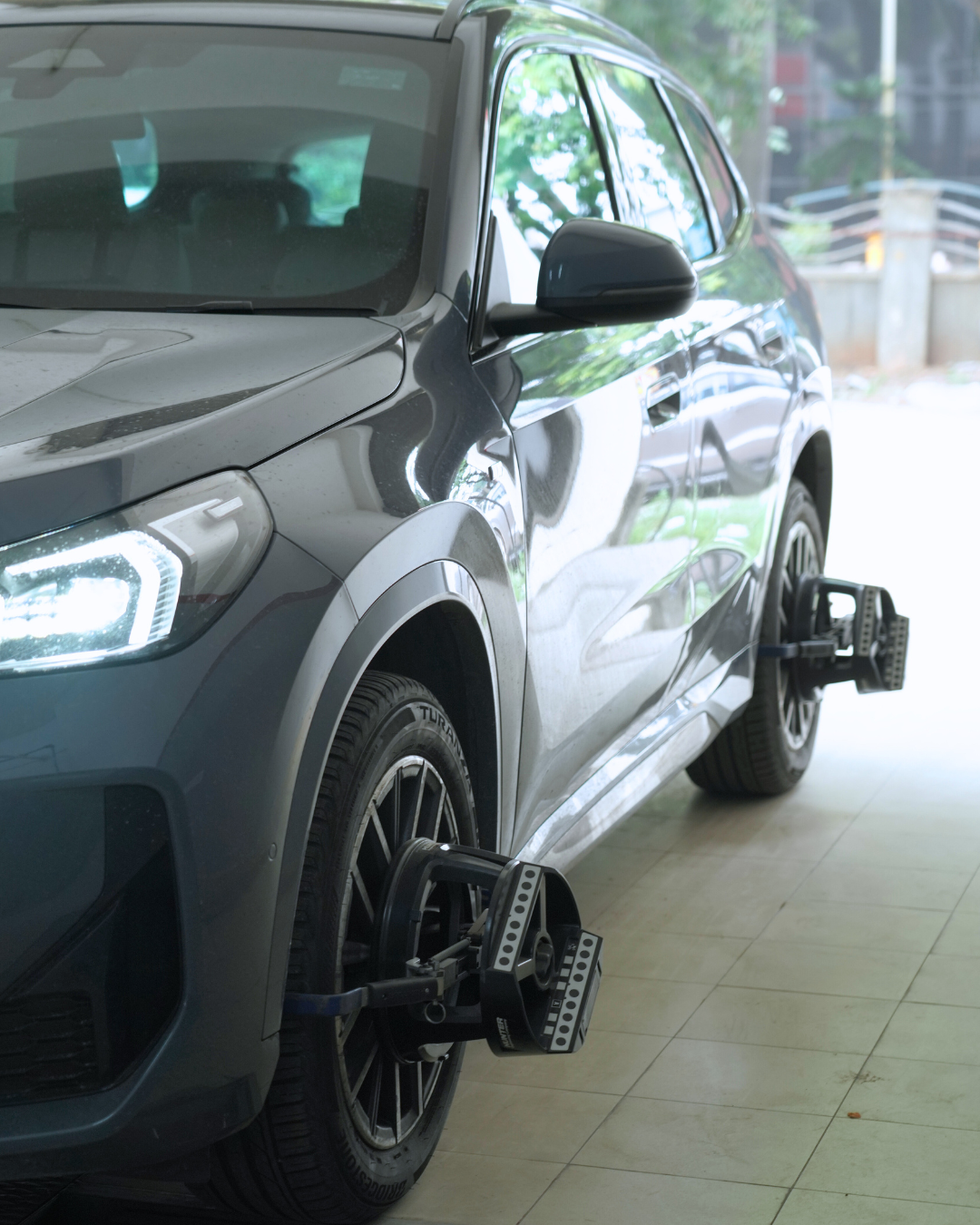
Wheel alignment is the precise geometric relationship between your tyres and the road surface — camber (the tilt of the wheel inward or outward), caster (the steering axis angle), and toe (whether the front of the tyres point slightly inward or outward). These angles are set at the factory to very tight tolerances and are critical to how the car handles, how the tyres wear, and how much fuel the car uses.
In Chennai’s driving conditions, alignment drifts for three reasons:
- Pothole and kerb impacts — a single hard hit can shift toe angle enough to cause tyre wear that is visible within 5,000 km
- Suspension component wear — as bushings soften and ball joints develop play, the geometry they hold in place starts to drift
- Road camber — Chennai’s roads are often cambered or uneven across their width; regular driving on these surfaces gradually pulls the alignment off its baseline
Symptoms that indicate alignment needs checking:
- The steering wheel sits slightly off-centre when driving straight — even a few degrees indicates the car is compensating for misalignment
- The car drifts to one side when you release the steering on a flat, straight road
- The front tyres are wearing faster on the inner or outer edge than the centre — classic misalignment wear pattern
- Increased rolling resistance — the car feels like it needs more throttle than it used to on the same roads
4. Tyre Wear in Chennai — Reading What Your Tyres Are Telling You
Tyre wear patterns are one of the most useful diagnostic tools in suspension assessment they record the history of how the car has been running. Chennai’s combination of heat, rough surfaces, and traffic creates specific wear patterns worth knowing:
- Centre wear — tyre pressure consistently too high. Chennai’s temperature swings between air-conditioned parking and 40°C outdoor heat cause significant pressure variation. Check pressures monthly, not just at service
- Edge wear on both sides — tyre pressure consistently too low. Underinflated tyres flex excessively and wear at the shoulders
- One-sided edge wear — camber misalignment. The wheel is tilted and the tyre is running on its edge
- Feathering or sawtooth wear — toe misalignment. The tyre is being dragged slightly sideways with every rotation
- Cupping or scalloping — worn shock absorbers. The tyre is bouncing rather than maintaining consistent road contact
If your tyres are wearing unevenly, the wear pattern tells you what to fix. Replacing the tyres without fixing the underlying cause just puts you back in the same position in 15,000 km.
5. Metro Construction and Diversion Roads — The Hidden Suspension Risk
Chennai’s ongoing metro expansion has created kilometres of temporary diversion roads loose gravel surfaces, uneven joins between old and new tarmac, and road edges that drop sharply where the surface has been dug up. These diversions are particularly damaging because they are unexpected and uneven in a way that standard city roads are not.
The advice here is simple: slow down significantly on any diversion road, regardless of how smooth it looks. A loose gravel surface with a hidden rut underneath causes more suspension damage than a visible pothole that you can steer around.
Suspension problems in Chennai rarely announce themselves dramatically. They build gradually a slight noise that becomes familiar, a tyre that wears a bit faster than expected, a steering feel that has softened from what it was. By the time something is clearly wrong, the damage has usually been accumulating for months. A suspension inspection and alignment check once a year, and after any significant impact, is the most cost-effective thing you can do for your car on Chennai roads. |
Frequently Asked Questions
Q: How often should wheel alignment be checked in Chennai?
A: Once a year as a minimum — and immediately after any significant pothole impact or kerb strike. If you are on OMR or Velachery roads regularly, twice a year is reasonable. Do not wait for visible tyre wear to check alignment; by then the wear is already done.
Q: Can a single pothole really damage the suspension on a premium car?
A: Yes — a hard impact at moderate speed can shift wheel alignment angles, crack a ball joint, deform a rim, or damage a tyre sidewall internally. The damage is not always immediately obvious, which is why an inspection after a significant impact is worth doing rather than waiting to see what develops.
Q: Why are my front tyres wearing unevenly in Chennai?
A: Uneven front tyre wear in Chennai is almost always caused by one of three things: wheel alignment that has drifted from a pothole impact or suspension wear, worn shock absorbers causing the tyre to bounce rather than roll smoothly, or tyre pressures that are not being checked regularly enough. The wear pattern tells you which one — bring the car in for an inspection and we can read it.
Q: Does wheel alignment affect fuel efficiency?
A: Yes. A misaligned tyre is being dragged at a slight angle with every rotation rather than rolling cleanly. This increases rolling resistance and fuel consumption. On a car driven 1,000 km a month in Chennai traffic, correct alignment makes a measurable difference to running costs over a year.
Q: What suspension components wear fastest on Chennai roads?
A: Anti-roll bar bushings and drop links, shock absorber seals, strut top mounts, and lower control arm ball joints — in roughly that order. These are all relatively straightforward replacements when caught at inspection. Leaving them until they fail completely usually involves additional damage to surrounding components.
Suspension inspection and wheel alignment in Chennai — Evolve Automotive, Guindy. |
Four-wheel alignment, suspension component inspection, shock absorber check, and tyre wear assessment for BMW, Mercedes-Benz, Audi, Volvo, Jaguar, Land Rover and all premium cars. |
Call / WhatsApp: 98849 88632 | 49, Guindy Industrial Estate, Chennai – 600032 | evolveautomotive.in/wheels-rims/ |