

Modern premium cars — BMW, Mercedes-Benz, Audi, Jaguar, Skoda — are built around intelligent ECU systems that monitor dozens of parameters simultaneously. These systems detect problems early and store fault information long before a dashboard warning light is triggered. In Chennai’s conditions sustained heat, monsoon humidity, stop-and-go traffic, and coastal salt air electronic and mechanical irregularities develop faster than in the European climates these cars were engineered for. Here are five signs that your premium car needs a diagnostic scan now — not when the light comes on.
+91 98849 88632 · Mon–Sat 10AM–7PM
1. Your Car Feels Slightly Less Responsive Than It Used To
This is the symptom owners most commonly dismiss because it happens gradually and there is no single moment where the difference is dramatic. A BMW 3 Series or Audi A4 that used to pull cleanly onto the airport flyover now feels slightly hesitant. The throttle response that felt immediate now has a small lag. The car still drives but it no longer drives the way it did.
What a diagnostic scan typically finds behind this symptom:
- Turbo pressure deviating from target — the turbocharger is producing less boost than the ECU is requesting, usually from wastegate wear or a small boost leak
- Fuel injector flow imbalance — one or more injectors delivering a slightly different fuel quantity, causing uneven power delivery across cylinders
- MAF sensor contamination — the mass airflow sensor is reading lower than actual airflow, causing the ECU to run a leaner fuel mixture than optimal
- Throttle body carbon deposits — restricting airflow at partial throttle, causing the hesitation that owners notice most during city driving
None of these faults trigger a warning light in early stages. All of them are straightforward to resolve when caught early and significantly more expensive when left until performance has deteriorated noticeably.
2. Subtle Gear Shift Hesitation in Traffic
Mercedes-Benz and Jaguar automatic transmissions are calibrated for seamless, almost imperceptible gear changes. When the transmission adaptation drifts out of its optimal range, the shifts become slightly noticeable. In Chennai’s stop-and-go traffic on routes like Guindy to T Nagar or the OMR IT corridor, the gearbox cycles through its lower gears thousands of times per day accelerating this drift faster than the global service schedule assumes.
Signs that the transmission needs a diagnostic read:
- A brief pause or hesitation when pulling away from a standstill the gearbox is slow to engage first gear
- A slight jerk between second and third gear during light acceleration in traffic
- The transmission taking a moment to find the right gear when you press the accelerator to overtake
- In advanced cases the gearbox holding a lower gear longer than it should before shifting up
Early transmission diagnostics can identify whether a fluid service, software update, or mechanical inspection is needed before the problem escalates.
3. Fuel Consumption That Has Gradually Increased
If you are refuelling more frequently on similar routes without a change in driving pattern, the car’s fuel system efficiency has dropped. Chennai’s traffic variation makes owners attribute the change to bad traffic days rather than a system fault which is exactly why this symptom gets ignored the longest.
Common causes a diagnostic scan will identify:
- Oxygen sensor reading lazy — the sensor response has slowed, causing the ECU to run a richer fuel mixture than necessary
- Throttle position sensor drift — the ECU is receiving a slightly incorrect signal about throttle opening, affecting fuel calculation
- Air-fuel ratio imbalance from a partially blocked injector one cylinder running rich while the ECU compensates across all cylinders
- EGR valve sticking open on diesel engines allowing exhaust gas into the intake when it should be closed, reducing combustion efficiency
4. Rough Idle or Vibration When Stationary at Signals
A premium car should idle without any perceptible vibration. When you notice a slight roughness, a periodic vibration, or an engine note that sounds uneven at idle, the combustion system is not firing uniformly across all cylinders. In Chennai, this is most noticeable at long traffic signals where there is no masking from road noise or acceleration.
- Ignition coil weakness — one coil producing a weaker spark, causing that cylinder to misfire intermittently at low load
- Carbon buildup on intake valves — particularly on direct-injection petrol engines like BMW’s B48 and Audi’s TFSI
- Spark plug wear — plugs past their service life cause inconsistent ignition, most noticeable at idle
- Early injector fault — an injector beginning to deliver inconsistently, causing a misfire the ECU stores but does not yet flag with a warning light
These faults store as pending or historical codes in the ECU — meaning they are detectable by a diagnostic scan even when no warning light is present.
Why a Preventive Diagnostic Scan Makes Financial Sense
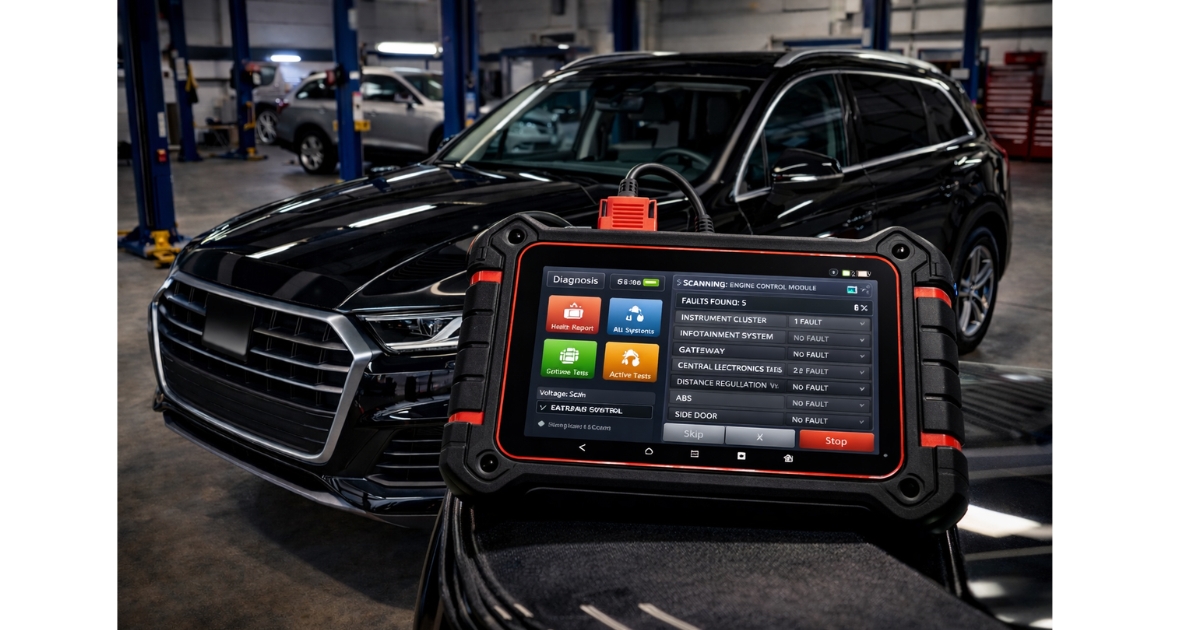
Premium car ECUs store three categories of fault information — active faults (currently occurring), pending faults (detected but not yet confirmed), and historical faults (occurred in the past and cleared). A warning light only appears for active faults that have crossed a severity threshold.
A preventive diagnostic scan reads all three categories — giving a complete picture of what has been happening to the car’s systems, not just what is happening right now. For most owners, a scan once a year or at every service interval is sufficient to stay ahead of developing faults before they reach the warning light stage.
The warning light is not the start of the problem — it is the point where the ECU has decided the problem is serious enough to tell you about it. At Evolve Automotive, every service visit includes a full diagnostic scan across all systems — engine, transmission, ABS, airbags, AC, and body electronics. We read the history, not just the current state.
The warning light is not the start of the problem — it is the point where the ECU has decided the problem is serious enough to tell you about it. At Evolve Automotive, every service visit includes a full diagnostic scan across all systems. We read the history, not just the current state. |
Why a BMW Front Bumper Is Not a Simple Swap
People sometimes assume a bumper replacement is straightforward take the old one off, put the new one on. On a BMW 320d it is a more involved job than that, and doing it carelessly creates problems that show up later.
The front bumper on the F30 320d carries the parking sensors, the front fog lamps, the lower grille, the bumper trim strips, and the impact absorber foam behind the outer skin. All of these need to come off the damaged bumper and be correctly transferred and refitted to the new one. The sensor brackets are fragile and often crack when removed roughly a new bracket costs more than the care it takes to remove the old one properly.
The bumper also has to fit correctly to the adjacent panels the front wings, the bonnet, and the lower lip. On a BMW, the panel gaps are tight and consistent. A bumper that is even slightly out of position reads as wrong immediately. Getting the fitment right requires checking the gaps against all surrounding panels before the bumper is bolted down, not after.
Frequently Asked Questions
Q: Should I wait for a warning light before getting a diagnostic scan?
A: No. Warning lights only appear when a fault has crossed a confirmed severity threshold. Pending and historical faults — which indicate problems that are developing — are only visible through a diagnostic scan. By the time the light appears, the fault has usually been present for some time.
Q: How often should I get a diagnostic scan on my European car in Chennai?
A: Once a year as a minimum, or at every scheduled service interval. If the car has been through monsoon flooding, taken a significant pothole impact, or started showing any of the symptoms above, a scan should be done promptly regardless of when the last one was.
Q: Does a diagnostic scan cover only the engine?
A: No. A full diagnostic scan covers all electronic systems — engine, transmission, ABS and stability control, airbag system, air conditioning, body electronics, and all other control modules. Each system has its own ECU with its own fault memory.
Q: Can Chennai’s climate actually affect my car’s ECU and sensors?
A: Yes. Heat accelerates sensor degradation, humidity causes connector corrosion, monsoon water ingress affects modules, and the thermal cycling between air-conditioned parking and outdoor heat stresses electrical connections over time. Chennai conditions create electronic faults that are rare in drier, cooler climates.
Q: My car drives fine — do I still need a diagnostic scan?
A: Yes — particularly if the car has not been scanned in the past year. Drives fine means no active fault has reached warning light severity. It does not mean no faults are present. A scan on a car that feels perfectly normal regularly reveals pending codes that would have become expensive problems within the next service interval.
Diagnostic scan for your European car in Chennai — Evolve Automotive, Guindy. |
Full multi-system diagnostic scan for BMW, Mercedes-Benz, Audi, Volvo, Jaguar, Land Rover, and Skoda. We read the history — not just the current state. Dealer-level diagnostic capability at independent workshop prices. |
Call / WhatsApp: 98849 88632 | 49, Guindy Industrial Estate, Chennai – 600032 | evolveautomotive.in/contact-us/ |